 St. Petersburg Siding
 Decks Take a Different Kind of Beating in Shore Acres
Shore Acres sits on St. Petersburg's canal network, which means most decks here aren't just outdoor living space — they're the transition point between the house and the water. That location comes with a combination of stresses you don't see the same way even a few miles inland. Salt-laden air moves off the canals and Tampa Bay all day, every day. Intense, nearly year-round Florida UV bakes the top side of the boards. Wind-driven rain during summer storms and hurricane season drives moisture sideways into joints and fastener holes instead of just falling straight down. And because so many Shore Acres lots sit low and close to the water, decks here deal with humidity and occasional flood exposure that a deck in a drier, higher part of Pinellas County simply doesn't.
None of that means a deck can't last in this neighborhood. It means the deck has to be built for these specific conditions — not built to a generic national spec and hoped to hold up. That's the difference between a deck replacement that gets you fifteen-plus years and one that starts showing soft spots, corroded hardware, or peeling finish within a couple of seasons.
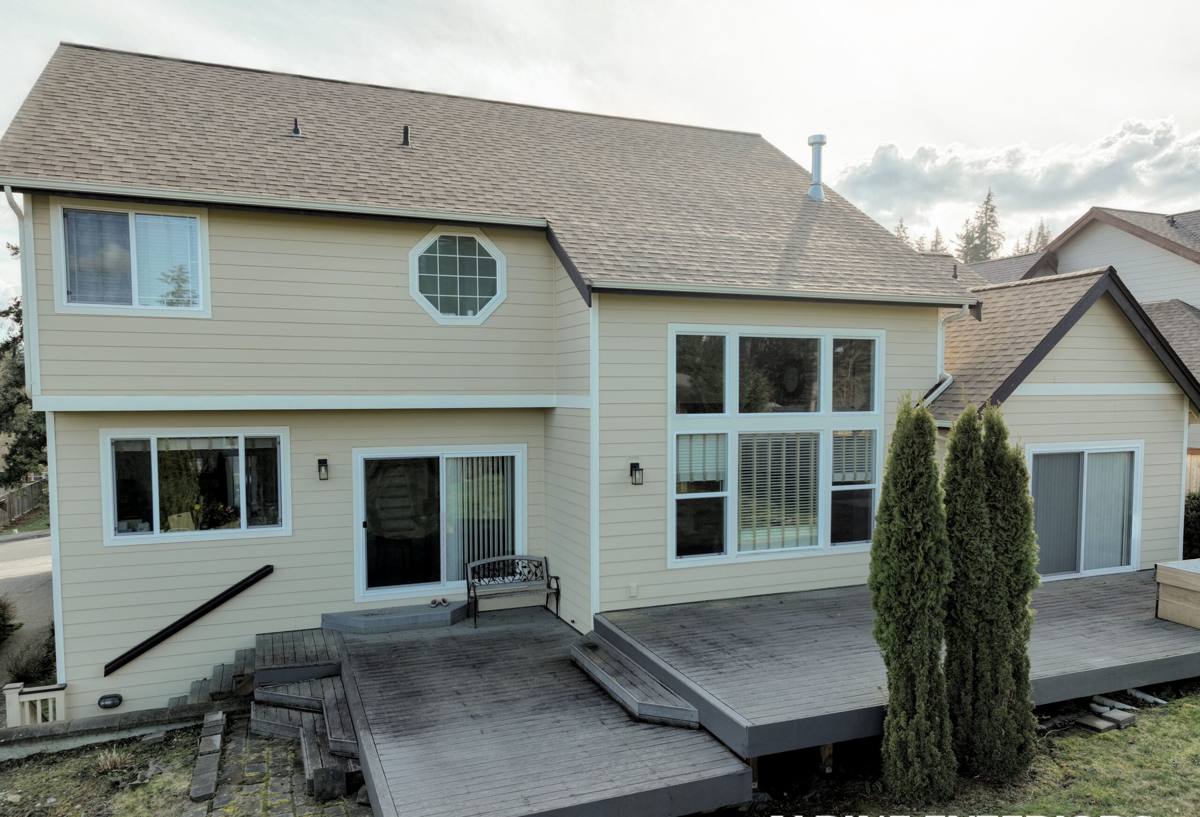
What Actually Wears Out a Shore Acres Deck
Salt Air and Corrosion
Canal-front and near-canal properties get a steady dose of airborne salt. It doesn't just dull metal — it accelerates corrosion in fasteners, joist hangers, and structural connectors far faster than the same hardware would wear a few miles from the water. A deck built with standard, non-marine-grade fasteners in this environment can develop rust streaks and weakened connections well before the decking surface itself looks like a problem.
UV Exposure
St. Petersburg gets sun most of the year, and a deck has no shade of its own during the hottest part of the day. UV breaks down wood fibers, fades color, and — in lower-quality composite products — can cause fading or surface chalking over time. Whatever material goes down needs UV-stable finishes or UV-resistant capping, not a coating that was really designed for a shadier climate.
Wind-Driven Rain and Moisture Intrusion
The problem with Florida rain isn't just volume — it's angle. Storms push rain sideways into ledger boards, stair stringers, and any spot where two pieces of framing meet. Without proper flashing and gapping, that moisture gets trapped and starts rot from the inside, which is exactly why so many "surface looks fine" decks turn out to have soft, failing joists underneath.
Flooding and Ground Moisture
Because of the low elevation and canal proximity common to this neighborhood, ground-level framing and footings can see standing water or saturated soil after heavy rain events and storm surge. Posts, footings, and any wood in ground contact need to be treated and detailed for that reality, not just for "occasional rain."
What a Correct Deck Replacement Actually Involves
A deck replacement is more than pulling up old boards and screwing down new ones. Done right, it starts below the surface:
- Full structural inspection of ledger board, joists, beams, posts, and footings — not just the decking
- Ledger board flashing that properly sheds water away from the house rim joist, a common failure point on older Florida decks
- Corrosion-resistant hardware — stainless steel or heavy hot-dip galvanized fasteners and connectors rated for coastal/salt-air exposure
- Proper joist spacing and blocking matched to the decking material's span rating, not stretched to save material
- Footings sized and set for local soil and flood conditions, not just minimum code depth
- Positive drainage — a slight slope and airflow underneath so water doesn't pool against framing
- Code-compliant railings and stairs, including guard height and baluster spacing where the deck height requires it
Skipping any one of these doesn't necessarily show up on day one. It shows up in year three or four, as soft spots near the house, wobbly railings, or fastener heads bleeding rust through the decking.
Choosing a Decking Material for This Environment
There's no single "right" material for every homeowner — it comes down to budget, maintenance tolerance, and how close to the water the property sits. Here's how the common options actually perform under Shore Acres conditions:
| Material | Salt Air / Corrosion | UV / Fade Resistance | Maintenance | Typical Lifespan |
|---|---|---|---|---|
| Pressure-treated wood | Framing holds up well if hardware is corrosion-rated; surface boards are more vulnerable | Fades and grays without regular sealing | Needs sealing/staining every 1–2 years in this sun | 10–15 years with upkeep |
| Composite decking | Not affected by salt itself; hardware still needs to be corrosion-rated | Good with quality capped products; lower-grade cores can fade or chalk | Occasional washing, no staining | 20–30 years |
| PVC/synthetic decking | Fully unaffected by salt exposure | Excellent UV stability on quality lines | Lowest maintenance of the group | 25+ years |
| Tropical hardwood | Naturally dense and rot-resistant; hardware still needs upgrading | Grays without oiling; oiling needed more often near water | Regular oiling to maintain color | 20–25 years |
For canal-front or near-canal lots specifically, we lean homeowners toward composite or PVC decking with stainless or coated marine-grade hardware, simply because it removes two of the biggest long-term maintenance headaches — fading and fastener corrosion — in an environment that punishes both. Wood is still a legitimate, more affordable choice for owners willing to stay on top of sealing.
Permitting and Code Realities for Waterfront Lots
Deck replacement on or near a Shore Acres canal isn't always a simple swap-in-kind job. Depending on the property, the scope can touch:
- Pinellas County or City of St. Petersburg building permits for structural deck work
- Setback rules for structures near canal seawalls or docks
- Wind load requirements for guardrails, post connections, and footings under current Florida Building Code
- Elevation considerations if the property has flood zone requirements tied to its finished floor or lowest horizontal structural member
We pull the required permits and handle inspections as part of the job — that's not an upsell, it's what keeps you from having an unpermitted structure flagged during a future sale or insurance review.
How Our Process Works
- On-site assessment — we inspect the existing deck's framing, ledger connection, footings, and hardware condition, not just the surface boards
- Honest scope discussion — full replacement vs. reframe-and-resurface, explained in plain terms with the trade-offs of each
- Material and design walkthrough — decking type, railing style, stair layout, and any features tied to the waterfront lot
- Permitting — we prepare and submit what's required for your jurisdiction and scope
- Demo and structural rebuild — old decking, framing, and hardware removed; new footings, joists, ledger flashing, and connectors installed to spec
- Decking, railing, and finish work — installed per manufacturer spacing and fastening requirements for the material chosen
- Final inspection and walkthrough — we confirm the work with you before calling the job done
Signs Your Shore Acres Deck Needs Replacing, Not Patching
Homeowners often ask whether they can get by with spot repairs. In this climate, that's worth a real inspection rather than a guess. Watch for:
- Soft, spongy, or bouncy spots anywhere on the deck surface
- Rust staining bleeding out around screw or nail heads
- Visible gaps, splitting, or separation where the deck meets the house
- Wobbly railings or posts that shift under hand pressure
- Wood that probes soft with a screwdriver near ground contact points or footings
- Persistent standing water or slow drainage after rain
- A deck older than 15–20 years that has never had a structural inspection
Any one of these on its own might be a repair. Two or more, especially involving the framing rather than just the surface, usually means replacement is the more honest and more cost-effective answer.
Why Hiring a Crew That Already Works Shore Acres Matters
A deck built to a generic spec sheet can look identical to one built for this neighborhood on installation day. The difference shows up over the following few storm seasons. A contractor who already works canal-front St. Petersburg properties knows to spec corrosion-rated hardware as standard rather than an upgrade, knows what Pinellas County and city inspectors are actually looking for on waterfront structural work, and has already seen which ledger and footing details hold up to this specific mix of salt air, sun, and wind-driven rain. That local track record is worth more than a lower bid from a crew that's never built this close to the bay.
Keeping a New Deck in Good Shape After Installation
Whatever material you choose, a few habits extend its life in this environment:
- Rinse off salt spray and debris periodically, especially after storms
- Keep gutters and downspouts clear so runoff isn't pouring directly onto or under the deck
- Check railing and stair connections once or twice a year for any looseness
- For wood or hardwood decking, stay on a sealing/oiling schedule rather than waiting until it visibly grays
- Keep an eye on any area where the deck meets the house for early signs of moisture staining
If you're weighing a deck replacement in Shore Acres, we're happy to walk the property, look at the framing and hardware condition honestly, and lay out real options and costs — no pressure, no upsell script. Use the form below to request a free estimate.